
Ebers–Moll transistor model, also known as the coupled diode model, was developed by Ebers and Moll in the year 1954. It is an ideal model for a bipolar transistor and is applicable for all four regions of transistor operation. The model involves two ideal diodes and two ideal current sources. Figure below shows the Ebers–Moll model for an NPN transistor.
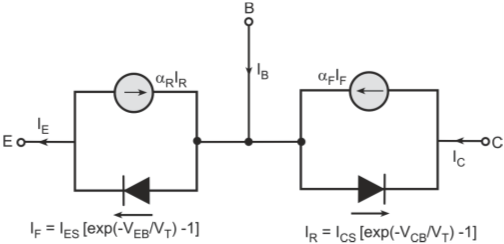
Ebers–Moll model for an NPN transistor
Figure below shows the Ebers–Moll model for a PNP transistor.
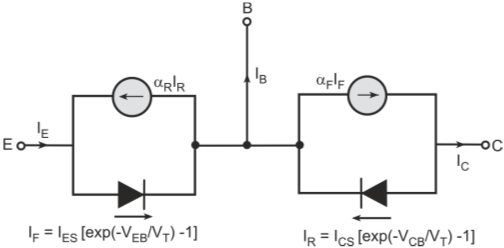
Ebers–Moll model for a PNP transistor
The two diodes represent the base–emitter and the base–collector diodes and
are connected back-to-back. The reverse saturation currents through the
base–emitter and the base–collector diodes are IES and ICS,
respectively. Two current sources are in shunt with the diodes and their values depend upon the current flowing through the diodes. They quantify the transport of minority carriers through the base region, that is, they account for the minority-carrier transport across the base.
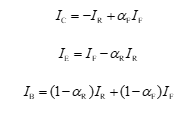
The equations for the collector, emitter and base currents in the Ebers–Moll model are given by
The Ebers–Moll parameters are related by the expression
