Current Shunt Feedback

  • What is a current-shunt (shunt–series) feedback amplifier?

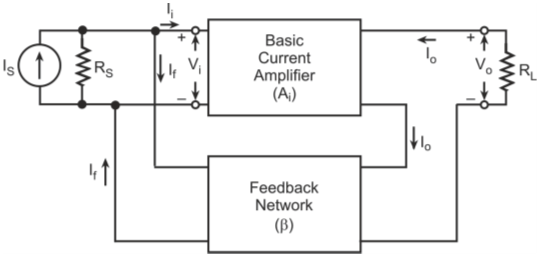
    In current-shunt (shunt–series) feedback, output current is sampled and mixed in shunt with the externally applied input signal.
  • Draw the block diagram and equivalent circuit for a current-shunt feedback amplifier?

    Figure below shows the block schematic arrangement of a generalized feedback amplifier with current-shunt feedback.

    Schematic arrangement of current-shunt (shunt–series) feedback amplifier

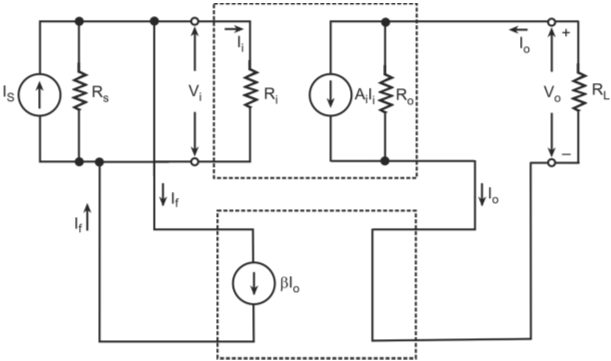
    Figure below shows the equivalent circuit for current-shunt feedback amplifier.

    Equivalent circuit for schematic arrangement of current-shunt feedback amplifier

  • What is the gain parameter for current-shunt feedback amplifier?

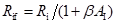
    Gain parameter for a current-shunt feedback amplifier is the current gain. Current gain with feedback AIf is given by

    Where,
    AI is current gain without feedback β is the feedback factor

  • What is the input resistance parameter for current-shunt feedback amplifier?

    The expression for input resistance is derived as follows.

    Substituting

    in the above equation, we get

    Now,

    Therefore,

    Also,

    where AI is the current gain without feedback taking load resistance into account. This gives

    Where,
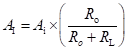
    AI is given by

    Where, Ai is the current gain without taking the load resistance RL into account. In fact, it is the short-circuited current gain. It can also be expressed as

  • What is the output resistance parameter for current-shunt feedback amplifier?

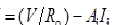
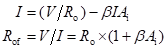
    Expression for output resistance is derived by considering Is = 0, letting load resistance RL = ∞ and applying a voltage V across the output. Ratio of applied voltage V to the resulting current I gives the output resistance.

    For,

    Where, Rof is the output resistance with feedback with RL = ∞ Considering the effect of load resistance RL, the output resistance with feedback Rof' is given by parallel combination of Rof and RL. R of' can also be expressed by

    Where,

    Also, for RL=∞ ,R'=R o and A1 =0 . Therefore,

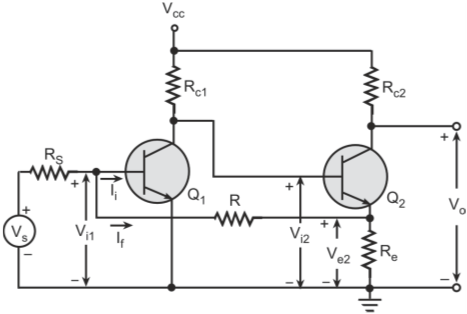
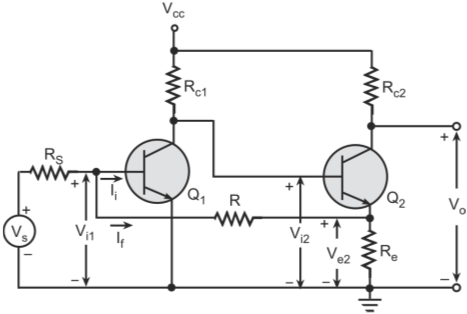
  • Refer to figure below. Which type of feedback is present in it?

    Cascade arrangement of common emitter amplifier stages

    The circuit in the figure is a cascade arrangement of two common-emitter amplifier stages with feedback from emitter of the second stage to the base of the first stage. It is an example of current-shunt feedback. The voltage across emitter resistor of the second stage is out of phase with the base voltage of the first stage, which confirms this to be a case of negative feedback. Also, the feedback current, that is the current flowing through resistor R, is proportional to the output current and the proportionality factor β is equal to Re/(Re + R).

  • Draw an op-amp based circuit having current-shunt feedback?

    Figure below shows op-amp-based inverting current amplifier having current-shunt feedback. The feedback factor in this case is given by [R1/(R1 + R2)].

    Op-amp-based current amplifier with current-shunt feedback

  • Why are current-shunt feedback amplifiers considered as good current amplifiers?

    Current-shunt feedback leads to very high output impedance and very low input impedance. These are the desirable traits of a good current amplifier.

Got a voltage spike of curiosity?

Send your doubts now!