Diodes-Packages Lead Identification and Testing

  • How can we identify from a device type number that it is a diode?

    Semiconductor diodes have a “1” prefixed in their type number identification.

  • What are the most commonly used diode packages?

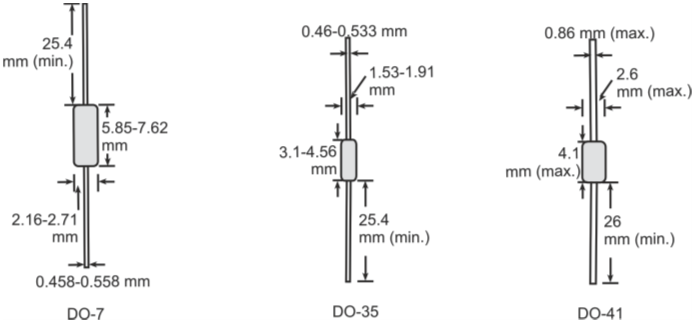
    Majority of semiconductor diodes are fabricated in one of the following package styles, namely DO-7, DO-35 and DO-41.

    Diode packages

  • How are the anode and cathode terminals marked in the diode packages?

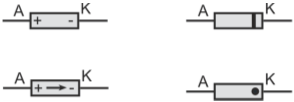
    Figure below shows the common marking styles for the anode and the cathode terminals. The most commonly used method is to put a circular band near the cathode and the other terminal without the band is the anode. One of the methods is to indicate the anode with a positive sign and the cathode with a negative sign. Yet another popular style of marking the diode’s leads is to put an arrow along the length of the diode with the arrow pointing towards the cathode or to put a dot near the cathode.

    Lead identification of diodes

  • How are the anode and the cathode terminals marked in case of Zener diodes?

    In the case of Zener diodes, a band is put near the cathode. In some Zener diodes, a positive sign (+) is put near the cathode lead with the other lead usually unmarked is the anode.

  • How is lead identification done in diodes?

    Lead identification in diodes can be done using a multimeter. Multimeter leads are connected to the diode and the multimeter is set to the position showing the diode symbol. If the display shows the cut-in voltage of the diode then the diode terminal connected to the red (positive) lead of the multimeter is the anode and the one connected to the black lead (negative) is the cathode. If the connections are reversed, the multimeter should show an OL. The test gives correct results only when the diode used is healthy.

  • Which instruments can be used to test diodes?

    Both P-N junction and Zener diodes can be tested using a digital or an analog multimeter, an ohmmeter, an oscilloscope or a curve tracer.

  • How can we test a P-N junction diode with a digital multimeter?

    Set the multimeter dial at a position showing the diode symbol. Connect the red (positive) lead of the multimeter to the anode and the black (negative) lead to the cathode so that the diode is forward-biased. The multimeter display provides an indication of its forward-bias voltage. An OL indication in this position indicates an open or a defective diode.

    Now interchange the multimeter leads to reverse-bias the diode. The multimeter will give an OL indication (open circuit) if the diode under test is healthy. A low resistance or a short circuit in this position indicates a shorted or a defective diode.

  • How can we test a P-N junction diode using an ohmmeter?

    Select the meter in one of the lower resistance ranges and connect the leads in such a way that the diode is forward-biased. For a healthy diode the meter shows a very low resistance confirming that the diode is working properly in the forward-bias mode. Now, interchange the leads to reverse-bias the diode. The multimeter would show an open circuit if the diode is healthy. An open circuit in both the tests and a low resistance or short in both the tests indicates an open and a shorted diode, respectively.

  • How can we check the functionality of a Zener diode?

    Perform the checks as mentioned above. In addition, for Zener diodes we check the Zener breakdown voltage. It is done by using a small test circuit as shown in Figure below. Resistance R is typically 100 Ω.

    The input DC voltage being fed from a regulated DC power supply is gradually increased. The voltage across the Zener diode is observed using a multimeter. The voltage across the Zener diode is almost equal to the input voltage, until it reaches the breakdown voltage. Beyond that, the output voltage stays put despite changes in the input voltage. This is the breakdown voltage of the Zener diode.
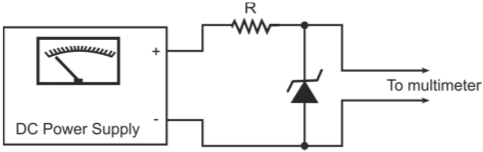
    Test set-up for measuring the breakdown voltage of a Zener diode

Got a voltage spike of curiosity?

Send your doubts now!