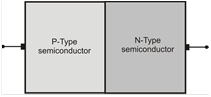
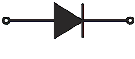
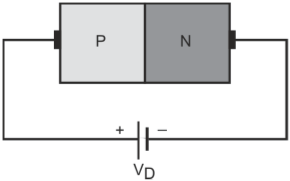
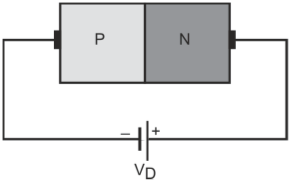
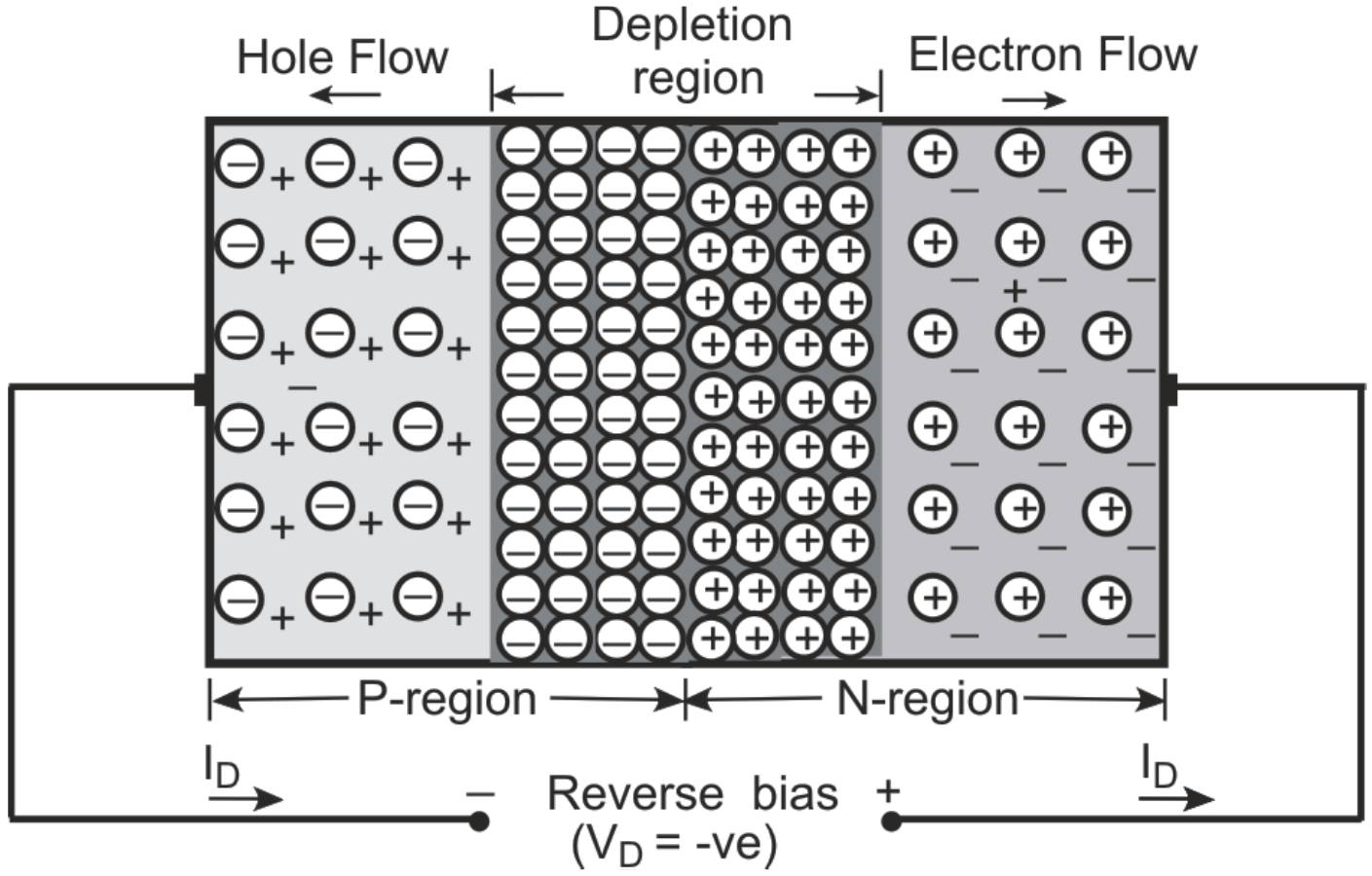
When the diode is forward biased, the applied potential causes the electrons in the N-region and the holes in the P-region to combine with positive and negative ions, respectively, in the depletion region. This results in a reduction of the width of the depletion region as shown in Figure below. In addition, the potential barrier at the junction also decreases.

Depletion region of a forward-biased diode
As the applied bias is increased in magnitude, the width of the depletion region decreases until a point is reached where there is a sharp rise in the number of majority carriers crossing the junction. A large number of holes cross the junction from the P-region to the N-region and a large number of electrons cross the junction from the N-region to the P-region. This results in exponential rise in the current due to the majority carriers.