Programmable Unijunction Transistors

  • What is a Programmable Unijunction Transistor (PUT)?

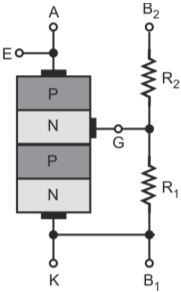
    PUT is a four-layer device like a thyristor with contacts, namely, anode (A) and cathode (K) made to the two extreme layers and a control contact called gate (G) made to one of the inner layers. In this case, the inner layer chosen is the one closer to the anode contact. The device is so called because it can perform functions similar to that of a UJT and is directly interchangeable with a UJT device. A PUT is designed to enable the engineer to program UJT parameters, which include inter-base resistance (RBB), intrinsic stand-off ratio (n), peak current (IP) and valley current (IV). Programming is possible with the help of two external resistors.
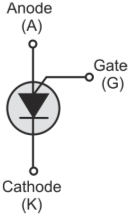
  • Draw the circuit symbol of PUT?

    Figure below shows the circuit symbol of a PUT.

    Circuit symbol of a PUT

  • Describe the construction of a PUT?

    Figure below shows the construction of a PUT. R1 and R2 are programming resistors. Different parameters are defined by the following equations.

    The peak current and valley current depend upon the equivalent resistance RG of the gate control circuit.

    PUT construction

  • Draw the V-I characteristics of a PUT device?

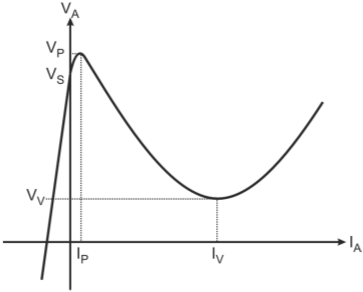
    Figure below shows the V-I characteristics of a PUT device.

    V–I characteristics of PUT

    The voltage VS appearing at the control terminal is given by

    Where,
    VB is the DC voltage applied at the B2 terminal
    When anode-to-cathode voltage exceeds VS by one diode voltage drop, the device goes to conduction.

  • What is the most common application of UJT and PUT devices?

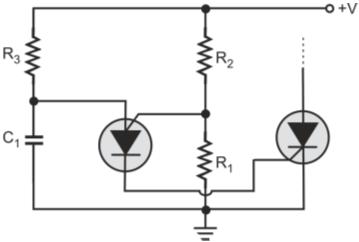
    Most common application UJT and PUT devices is in triggering of thyristors. Figure below shows the triggering of thyristor using a PUT device.

    Thyristor triggering with a PUT device

Got a voltage spike of curiosity?

Send your doubts now!